

Table of Contents
- What Saponification Actually Does to Your Skin
- Handmade Soap vs Commercial Soap: What the Label Won't Tell You
- Glycerin in Soap Benefits: The Humectant Commercial Bars Strip Away
- Plant-Based Oils, Butters, and Superfatting for Sensitive Skin
- The Best Soap for Athletes: Post-Training Skin Defense
- Storage and Longevity: Making Handmade Bars Last
- Conclusion
- Frequently Asked Questions
Last Updated: September 11, 2026
What Saponification Actually Does to Your Skin
Saponification is the chemical reaction that turns fats and an alkali into soap and glycerin. When a fat or oil meets sodium hydroxide in water, the triglyceride molecules split apart and recombine into two things: soap and glycerin. That glycerin stays inside a handmade bar. This is the first reason why handmade soap is better for skin, and it's a chemistry fact, not a marketing claim.
Commercially made bars often have that glycerin extracted and sold separately to cosmetics manufacturers. What's left is a bar that cleans but strips. At Forged & Foam Co., we keep the glycerin where it belongs: in the bar.
Handmade Soap vs Commercial Soap: What the Label Won't Tell You
The difference between handmade soap vs commercial soap usually comes down to three things: glycerin content, detergent type, and additives. Commercial bars frequently replace real soap with synthetic detergents and surfactants, which clean aggressively but don't distinguish between dirt and your skin's natural oils.
Handmade bars rely on the saponified oils themselves as the cleanser. The FDA's guidance on cosmetic versus soap labeling is worth reading here, because it explains why many "beauty bars" legally aren't soap at all.
| Feature | Handmade Soap | Commercial Bar |
|---|---|---|
| Primary cleanser | Saponified plant oils | Synthetic detergents |
| Glycerin | Retained | Often removed |
| Fragrance | Essential oils | Artificial fragrances |
| Preservatives | Usually none | Common |
| Skin conditioning | High (superfatting) | Minimal |
Reading Ingredient Labels Like a Formulator
Start at the top. Ingredients are listed by weight, so the first three tell you what the bar actually is.
- Sodium olivate, sodium cocoate, sodium shea butterate = real saponified oils
- Sodium lauryl sulfate, sodium laureth sulfate = synthetic surfactants
- Parabens, phthalates, "fragrance" = preservatives and undisclosed scent blends
- Glycerin listed high = good sign; missing entirely = likely stripped
If you can't pronounce the first five ingredients, that's information.
Glycerin in Soap Benefits: The Humectant Commercial Bars Strip Away
Glycerin in soap benefits come down to one word: humectant. But the reason it matters so much in a bar of soap is mechanical, not marketing.
Glycerin is a polyol, a molecule with three hydroxyl (-OH) groups. Those groups form hydrogen bonds with water. When glycerin sits on your skin, it grabs water molecules from the air and from the deeper layers of your epidermis and holds them at the surface. That is what "humectant" means in practice: it doesn't add oil, it doesn't seal the skin like an occlusive, it pulls and holds water where your barrier needs it.
Why Commercial Bars Don't Have It
During saponification, roughly 10 to 12 percent of the finished reaction mass is glycerin (peer-reviewed research). In a handmade bar, that glycerin stays in the bar. In large-scale commercial soap production, the crude soap is washed with salt water, which separates the glycerin into a dense liquid layer. Manufacturers skim it off and sell it, it goes into lotions, toothpaste, cough syrup, and food products. The remaining soap is then dried, extruded, and pressed into bars.
The result is a bar that cleans effectively but has lost the single most skin-friendly molecule the saponification reaction produced. That is why a commercial bar can leave your skin feeling tight even when the ingredient list looks harmless.
What Glycerin Actually Does to the Barrier
Your skin barrier is a lipid matrix, ceramides, cholesterol, and fatty acids arranged in a brick-and-mortar structure. When that matrix is intact, water stays in and irritants stay out. When it's compromised, you get the classic signs: tightness, flaking, itch, and reactivity to products that never bothered you before.
Glycerin supports that matrix in two ways. First, it keeps the outer layer of skin hydrated, which keeps the corneocytes (the flat cells that make up the surface) pliable instead of brittle. Second, hydrated skin is more resistant to penetration by surfactants, which means the cleanser itself does less damage on the way through.
The Squeaky-Clean Myth
That tight, squeaky feeling after washing isn't cleanliness. It's your lipid layer asking for help. A bar with retained glycerin cleans without that rebound. If you've switched to handmade soap and noticed your skin feels softer after a shower rather than tighter, glycerin retention is a large part of why.
How to Tell If a Bar Still Has Its Glycerin
You can't always tell from the label, because glycerin is a natural component of saponified oils and doesn't have to be listed separately. But there are practical signals:
- Translucent or slightly soft bars tend to retain more glycerin than hard, opaque, milled bars.
- A bar that sweats in humid weather is drawing moisture from the air, that's the glycerin doing its job.
- A bar that feels slick or slightly tacky when wet usually has higher glycerin content than one that feels chalky.
- A bar that dissolves quickly in a wet dish is a glycerin-rich bar. That's the trade-off: more skin benefit, shorter lifespan unless you store it well.
That last point is the honest downside of glycerin retention, and it's why storage matters as much as formulation. A glycerin-rich bar left sitting in water will disappear in days. Kept on a draining dish and rotated between uses, it will outlast a commercial bar by a wide margin in terms of actual skin benefit per wash.
Plant-Based Oils, Butters, and Superfatting for Sensitive Skin
Superfatting means deliberately leaving a percentage of unsaponified oil in the finished bar. That extra oil acts as an emollient, coating the skin with a thin layer of plant-based oils that supports the skin barrier rather than tearing it down.
Most handmade formulators superfat between 5 and 8 percent for body bars (peer-reviewed research). Bars built for sensitive or reactive skin often push to 8 to 10 percent. Go too high and the bar turns soft, lathers poorly, and can go rancid faster. Go too low and you've basically made a commercial bar with better intentions.
The Fatty-Acid Mechanism
Every plant oil is a blend of fatty acids, and each fatty acid behaves differently on skin. This is the part most guides skip.
- Oleic acid (high in olive, avocado, and sweet almond oil) is a monounsaturated fatty acid that absorbs relatively slowly and leaves a conditioning film. It's gentle and well-tolerated by most skin, but on genuinely acne-prone skin it can feel heavy.
- Lauric acid (high in coconut and palm kernel oil) is what gives soap its big, fluffy lather and its cleansing power. It's also the most stripping of the common soap fatty acids, which is why a 100 percent coconut oil bar will wreck a sensitive barrier.
- Stearic and palmitic acids (high in shea butter, cocoa butter, and tallow) are saturated fatty acids that produce a hard, long-lasting bar with a creamy, low lather. They're the conditioning backbone of most sensitive-skin formulations.
- Linoleic acid (high in sunflower, safflower, and hemp oil) is a polyunsaturated fatty acid that's lightweight and absorbs quickly. It's often the fix for skin that finds olive oil too heavy.
The blend matters more than any single ingredient. A bar that's 30 percent coconut oil will clean hard no matter how much shea you add. A bar that's 50 percent olive oil with 20 percent shea and 15 percent coconut will clean gently and condition well for most people.
Matching the Bar to the Skin Condition
Generic advice doesn't help when you're dealing with a specific issue. Here's how the fatty-acid profile maps to common concerns.
Eczema-prone skin. The barrier is already compromised, so the goal is minimal disruption. Look for high oleic and stearic content, olive, shea, and a modest amount of coconut for lather. Avoid high-lauric bars and anything with added fragrance. Unscented or essential-oil-only formulations are usually the safer bet. Many people with eczema find that a plain olive-shea bar with no scent works better than any medicated commercial cleanser.
Psoriasis. Scaling and rapid cell turnover mean the skin is both sensitive and in need of gentle exfoliation. A bar with a small amount of oatmeal or finely ground pumice can help, but the base should still be conditioning. Shea-heavy bars tend to be well-tolerated. Hot water and long showers do more damage than the soap itself, so keep water temperature moderate.
Acne-prone skin on the face and body. This is where the "natural is always gentler" assumption breaks down. Heavy butters like cocoa and shea can clog pores on some people. A lighter blend built around olive, sunflower, and a moderate amount of coconut often works better. Superfat around 5 percent rather than 8 to 10, enough to condition, not enough to leave residue.
Post-shave and post-training irritation. Barrier disruption plus open micro-abrasions. A high-superfat bar with shea and a low-lauric profile cleans without stinging. Avoid anything with citrus essential oils, which are phototoxic and can irritate freshly shaved skin.
Troubleshooting Common Reactions
- Post-wash tightness: your bar is too cleansing. Switch to a higher superfat or a bar built around olive and shea.
- Flaking on forearms and shins: your lipid layer is depleted. Add a glycerin-rich bar and reduce wash frequency.
- Itch after showering: often a fragrance issue. Try an unscented or essential-oil-only bar.
- Breakouts on shoulders and back: heavy butters can clog pores on some sensitive skin. A lighter olive-coconut blend often works better.
- Rancid smell or orange spots on the bar: the superfat is too high or the bar wasn't cured long enough. Most handmade bars need four to six weeks of cure time before they're at their best.
The honest summary: handmade soap isn't automatically better for every skin condition. It's better because you can choose a fatty-acid profile that matches your skin, which is something a mass-market bar simply can't offer.
The Best Soap for Athletes: Post-Training Skin Defense
The best soap for athletes is one that cleans aggressively enough to remove sweat, mat grime, and bacteria without stripping the skin barrier that protects against infection. For grapplers, that balance is everything.
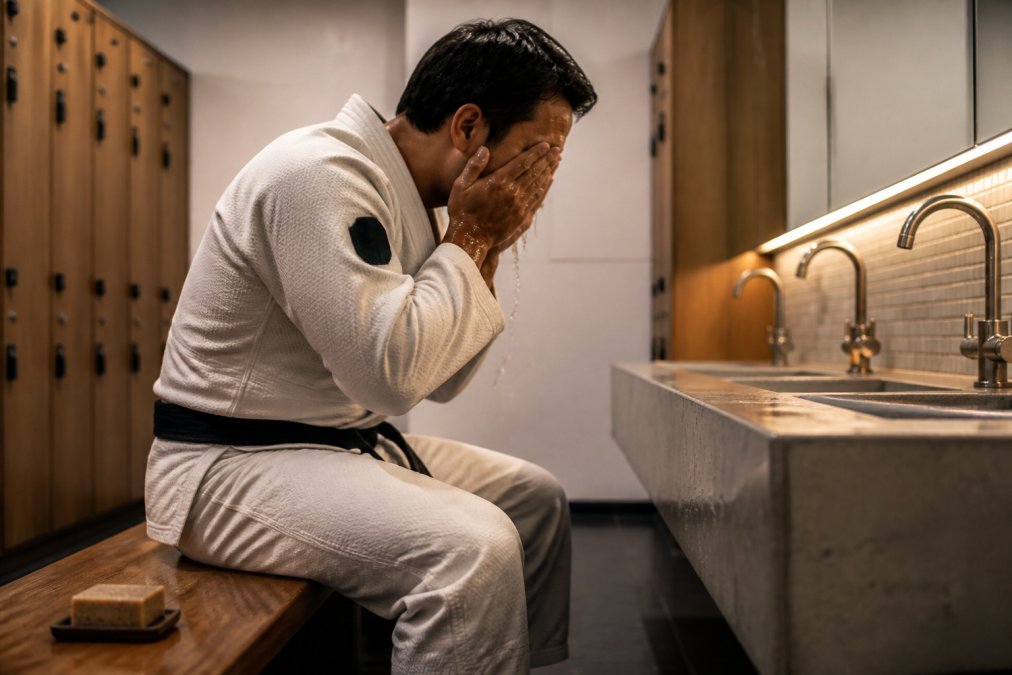
Synthetic detergents can leave micro-irritation that opens the door to skin issues. A well-formulated handmade bar cleans thoroughly while leaving the barrier intact. For gear, an antimicrobial spray handles what soap can't reach. Forged & Foam Co. builds both, formulated around plant-based oils and essential oils rather than cheap fragrance oils.
Storage and Longevity: Making Handmade Bars Last
Handmade bars have no preservatives, so how you store them decides how long they last. Water is the enemy.
- Use a draining dish. A bar sitting in a puddle dissolves in days.
- Cut large bars in half. Use one, store the other dry.
- Keep a spare in a cool, dark cabinet. Out of direct sun and humidity.
- Rotate bars. Let each one dry fully between uses.
A properly stored handmade bar can last weeks longer than one left on a wet shower ledge. This is the practical side of natural skincare that most guides skip.
Conclusion
The real reason handmade soap works better isn't romance or nostalgia. It's chemistry: retained glycerin, superfatted oils, and no synthetic detergents tearing at your skin barrier every wash. For athletes training five days a week, that difference shows up fast.
Forged & Foam Co. makes bars the slow way, with organic butters, fatty oils, and essential oils, plus antimicrobial gear sprays built for post-training routines. Every purchase helps fund tournament fees and scholarships for young athletes. Subscribe to our newsletter to see what's next.
Frequently Asked Questions
What are the primary skin benefits of using handmade soap?
Handmade soap retains the natural glycerin created during saponification, which draws moisture to your skin and supports the lipid layer. It typically skips synthetic detergents, parabens, and artificial fragrances that can disrupt pH balance. Plant-based oils like olive and coconut provide essential fatty acids, while superfatting leaves a conditioning emollient layer. Together these help maintain the skin barrier, making handmade soap a better fit for dry or sensitive skin than most commercial bars.
Is handmade soap better for sensitive skin?
Often, yes. Sensitive skin reacts to surfactants, synthetic preservatives, and fragrance compounds common in mass-produced bars. Handmade soap made with simple ingredients like shea butter, olive oil, and essential oils reduces exposure to those irritants. That said, natural does not automatically mean non-irritating. Essential oils and some plant extracts can still trigger reactions. Patch-test a new bar on your inner arm for 24 hours before using it on your face or full body.
Does handmade soap contain glycerin, and why does it matter?
Glycerin is a natural byproduct of saponification, and handmade soap keeps it in the finished bar. Commercial manufacturers often extract glycerin to sell separately, leaving a bar that cleans but does not condition. As a humectant, glycerin pulls water from the air into your skin and helps moisture retention. For athletes showering after every training session, that extra conditioning matters because frequent washing strips the skin barrier faster than occasional washing.
How should I store handmade soap so it lasts longer?
Handmade bars have no synthetic hardeners, so they dissolve faster if left in standing water. Keep your bar on a draining soap dish with raised ridges so air reaches all sides between uses. Store backup bars in a cool, dry place away from direct sunlight; a linen closet works well. If you rotate between several bars, let each one dry fully before stacking. Properly stored, an unused handmade bar keeps its scent and texture for roughly a year.
Comments
Leave a comment